
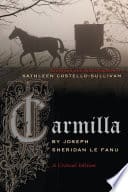
Carmilla
by Joseph Sheridan Le Fanu
Description
First serialized in the journal "The Dark Blue" and published shortly thereafter in the short story collection In a Glass Darkly, Le Fanu’s 1872 vampire tale is in many ways the overlooked older sister of Bram Stoker’s more acclaimed Dracula. A thrilling gothic tale, Carmilla tells the story of a young woman lured by the charms of a female vampire. This edition includes a student-oriented introduction, tracing the major critical responses to Carmilla, and four interdisciplinary essays by leading scholars who analyze the story from a variety of theoretical perspectives. Ranging from politics to gender, Gothicism to feminism, and nineteenth-century aestheticism to contemporary film studies, these critical yet accessible articles model the diverse ways that scholars can approach a single text. With a glossary, biography, bibliography, and explanatory notes on the text, this edition is ideal for students of Irish and British nineteenth-century literature.
Book Details
You Might Also Like
The Smell of Books
Hans J. Rindisbacher

A Study Guide for "The DaVinci Code"
Gale, Cengage Learning
Contemporary Dystopian Fiction for Young Adults
Balaka Basu, Katherine R. Broad, Carrie Hintz
What to Read and Why
Francine Prose
Anna Karenina
Leo Tolstoy
50 Books to Read If You're an Armchair Detective
Eric Karl Anderson
Why Was Billy Bunter Never Really Expelled?
Dennis Butts, Peter Hunt
The Hidden Adult
Perry Nodelman
The Old Man and the Sea
Gerry Brenner
Theorizing Twilight
Maggie Parke, Natalie Wilson
About the Author
Joseph Sheridan Le Fanu
Joseph Thomas Sheridan Le Fanu, popularly known as J. S. Le Fanu, was an Irish writer. He was one of the pioneers of early Gothic, mystery and horror literary works, and is considered by critics to be among the greatest ghost story writers of the Victorian era, as his works were central to the development of the genre. Le Fanu is best known for the locked-room mystery-thriller Uncle Silas (1864), the historical mystery novel The House by the Churchyard (1863), and the collection of stories In a Glass Darkly (1872), which includes the novella Carmilla (1872), one of the foundational works of vampire fiction and a landmark in the lesbian vampire genre.
No account connected — sign in to comment.