
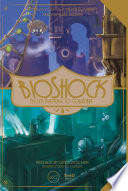
A unique and extraordinary saga of video games. In just three installments, the BioShock saga made a special place for itself in the hearts of players. These games boast completely unique and extraordinary stories and worlds. The first two installments take place in the underwater city of Rapture. Immersed in the Art Deco style and a 1950s atmosphere, the player advances through an open, intelligent gameplay that encourages creativity and careful use of the resources provided by the surroundings. BioShock Infinite, the third installment, draws us in to explore the floating city of Columbia in a uchronic, steampunk-laden 1912.Third Éditions aims to pay tribute to this hit series—which, despite its short history, has already gained critical acclaim. Dive into this unique volume that explores the games’ origins and provides an original analysis of each installment. Discover a complete analysis of the three installments of the BioSchok Saga! The video game will not have secrets for you anymore ! EXTRACT After years marked by total abstruseness, the early 2000s saw the transition of PC games to the world of consoles. In market terms, game consoles had reached a general-public status, ensuring high popularity—but the PC market put up strong resistance, in particular by selling downloadable games through stores such as Steam. Numerous PC-based developers, such as Warren Spector (Deus Ex, Epie Mickey), Peter Molyneux (Populous, Fable), and of course Ken Levine, began developing for consoles. In the same vein, numerous genres that were typically destined for PC gaming began migrating to consoles. This change certainly had numerous causes, one being Microsoft’s arrival on the console market with Xbox (with architecture close to a PC). In addition, typical inconveniences in PC development were eliminated (games no longer had to be designed for a wide variety of configurations, as a console by nature has a stable internal architecture). Finally, there was the question of pirating—even though it exists on consoles, it is much more common on PCs. ABOUT THE AUTHORS Nicolas Courcier and Mehdi El Kanafi - Fascinated by print media since childhood, Nicolas Courcier and Mehdi El Kanafi wasted no time in launching their first magazine, Console Syndrome, in 2004. After five issues with distribution limited to the Toulouse region of France, they decided to found a publishing house under the same name. One year later, their small business was acquired by another leading publisher of works about video games. In their four years in the world of publishing, Nicolas and Mehdi published more than twenty works on major video game series, and wrote several of those works themselves: Metal Gear Solid. Hideo Kojima’s Magnum Opus, Resident Evil Of Zombies and Men, and The Legend of Final Fantasy VII and IX. Since 2015, they have continued their editorial focus on analyzing major video game series at a new publishing house that they founded together: Third. Raphaël Lucas - Raphaël has over fifteen years of experience in the world of video game writing. A reader of Tilt and a fan of a renowned French video game journalist AHL, he first pursued a university éducation. After obtaining a master‘s degree in history from the University of Paris 1, he then became a freelancer for PC Team before working for Gameplay RPG and PlayMag. In October 2004, he joined the group Future France and worked for Joypad, PlayStation Magazine, Consoles + and Joystick, not to mention a few other contributions to film magazines. Today, he writes for Jeux Vidéo Magazine as well as the magazine The Game. He is also the co-author of The Legend of Final Fantasy IX.
Average Rating
Informations
About the author
Nicolas Courcier, Mehdi El Kanafi, Raphaël Lucas
Author
BioShock
by Nicolas Courcier, Mehdi El Kanafi, Raphaël Lucas
Books Like BioShock
If you're looking for books similar to BioShock, here are some recommendations based on themes, tone, and narrative style.

Portal
Valve Corporation
A puzzle game that revolutionized narrative design in video games. Players navigate test chambers using a portal gun, uncovering a dark story of scientific experimentation. The game combines dark humor, innovative gameplay mechanics, and a compelling narrative about artificial intelligence. Its clever storytelling and unique world mirror BioShock's approach.

Half-Life
Marc Laidlaw
A groundbreaking first-person narrative exploring scientific experimentation gone wrong. The game follows Gordon Freeman, a scientist who must survive after a teleportation experiment causes a catastrophic alien invasion. It revolutionized storytelling in video games with immersive world-building and complex narrative techniques. The game blends science fiction, horror, and action in a deeply engaging experience.

System Shock 2
Ken Levine
A spiritual predecessor to BioShock that pioneered narrative-driven first-person gameplay. Set on a starship overrun by a mysterious infection, players must survive and uncover the dark story. The game features immersive storytelling, complex character interactions, and a haunting atmosphere. It heavily influenced BioShock's design and narrative approach.
Fallout: New Vegas
Obsidian Entertainment
A post-apocalyptic RPG with complex narrative branching and player choice. Set in a retro-futuristic wasteland, players navigate intricate political and social dynamics. The game offers deep world-building, multiple narrative paths, and rich character interactions. Its commitment to player agency and narrative complexity echoes BioShock's design philosophy.

Spec Ops: The Line
Yager Development
A military shooter that deconstructs traditional war game narratives. Players experience a psychological descent into moral ambiguity during a Dubai mission. The game offers a critical examination of player agency and narrative expectations. Its commitment to challenging player perspectives mirrors BioShock's narrative complexity.

Deus Ex
Warren Spector
A cyberpunk action RPG that explores themes of technological transformation and human augmentation. The game follows JC Denton, a nano-augmented agent navigating a complex world of conspiracy and global control. It offers player choice and multiple narrative paths, similar to BioShock's innovative gameplay. The narrative critically examines technological progress and human identity.
The Stanley Parable
Davey Wreden
A meta-narrative game exploring player choice and game design conventions. Players follow a seemingly simple office worker's story, with multiple narrative branches challenging traditional gameplay. The game deconstructs narrative expectations and player agency. Its innovative storytelling approach shares BioShock's commitment to narrative complexity.

Wolfenstein: The New Order
MachineGames
An alternate history shooter exploring themes of resistance and technological dystopia. Set in a world where Nazis won World War II through advanced technology, players fight against a totalitarian regime. The game offers compelling narrative, complex characters, and immersive world-building. Its exploration of technological themes parallels BioShock's narrative approach.

Dishonored
Harvey Smith
A stealth action game set in a dystopian steampunk world with rich narrative complexity. Players control an assassin seeking revenge in a plague-ridden city with multiple gameplay approaches. The game offers deep world-building, moral choices, and atmospheric storytelling. Its unique aesthetic and narrative depth echo BioShock's innovative design.

Soma
Frictional Games
A science fiction horror game exploring consciousness and technological identity. Set in an underwater research facility, players confront existential questions about humanity and artificial intelligence. The game offers a deeply philosophical narrative with psychological horror elements. Its exploration of technological themes mirrors BioShock's narrative depth.

The Talos Principle
Croteam
A philosophical puzzle game exploring artificial intelligence and consciousness. Players solve complex puzzles while uncovering a narrative about technological existence. The game offers deep philosophical exploration of identity and intelligence. Its intellectual approach to technological themes resonates with BioShock's narrative depth.

Prey
Arkane Studios
A science fiction game exploring themes of identity and technological transformation. Players navigate a space station overrun by shape-shifting aliens, making complex narrative choices. The game offers deep environmental storytelling and player agency. Its psychological depth and immersive world design recall BioShock's narrative techniques.

Metro 2033
Dmitry Glukhovsky
A post-apocalyptic shooter set in the Moscow metro system after nuclear war. Players navigate a complex social ecosystem of survival and conflict. The game offers rich world-building, atmospheric storytelling, and deep narrative complexity. Its immersive environment and narrative depth echo BioShock's design principles.
Singularity
Raven Software
A first-person shooter with time manipulation mechanics and complex narrative design. Players investigate a mysterious Russian island with experimental technology that allows time manipulation. The game offers intricate storytelling, scientific speculation, and alternate history elements. Its narrative complexity and scientific themes recall BioShock's approach.
No account connected — sign in to comment.