
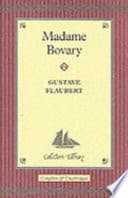
Madame Bovary tells the tragic tale of a beautiful young woman who tries to escape the narrow confines of her life and marriage through a series of passionate affairs--all in hopes of finding the romantic ideal she has always longed for. But her recklessness comes back to haunt her, and the strong-willed and independent Emma finds herself in a desperate fight for existence. Flaubert's daring depiction of adultery caused a national scandal when it was first published, and the author was put on trial for offending public morality. One hundred and fifty years later, this masterpiece of realist literature has lost none of its impact. The world's greatest works of literature are now available in these beautiful keepsake volumes. Bound in real cloth, and featuring gilt edges and ribbon markers, these beautifully produced books are a wonderful way to build a handsome library of classic literature. These are the essential novels that belong in every home. They'll transport readers to imaginary worlds and provide excitement, entertainment, and enlightenment for years to come. All of these novels feature attractive illustrations and have an unequalled period feel that will grace the library, the bedside table or bureau.
Average Rating
Informations
About the author
Gustave Flaubert
Author
Gustave Flaubert was a French novelist. He has been considered the leading exponent of literary realism in his country and abroad. According to the literary theorist Kornelije Kvas, "in Flaubert, realism strives for formal perfection, so the presentation of reality tends to be neutral, emphasizing the values and importance of style as an objective method of presenting reality". He is known especially for his debut novel Madame Bovary (1857), his Correspondence, and his scrupulous devotion to his style and aesthetics. The celebrated short story writer Guy de Maupassant was a protégé of Flaubert.
Madame Bovary
by Gustave Flaubert
Books Like Madame Bovary
If you're looking for books similar to Madame Bovary, here are some recommendations based on themes, tone, and narrative style.

Anna Karenina
Leo Tolstoy
A profound exploration of a married woman's passionate affair and societal constraints. Like Emma Bovary, Anna seeks romantic fulfillment outside her marriage, challenging 19th-century social norms. The novel delves deep into her psychological complexity and the devastating consequences of her choices. Tolstoy's masterpiece offers a nuanced portrayal of love, desire, and personal freedom.
Middlemarch
George Eliot
A complex narrative exploring individual lives within a broader social context. The novel features multiple characters wrestling with personal aspirations and societal constraints. Like Madame Bovary, it offers a deep psychological examination of characters' inner lives and romantic struggles. Eliot provides a rich, multilayered exploration of human motivation and social dynamics.

The Age of Innocence
Edith Wharton
A sophisticated exploration of forbidden love in New York's high society. The novel examines the tension between personal desire and social expectations, much like Madame Bovary. Characters struggle against restrictive social norms while navigating complex romantic relationships. Wharton's nuanced portrayal of emotional repression offers a compelling parallel to Flaubert's work.

The Portrait of a Lady
Henry James
A sophisticated novel about a young woman's journey of self-discovery in European and American society. The protagonist, Isabel Archer, navigates complex personal and social challenges while maintaining her independence. James explores themes of personal freedom, romantic expectations, and societal pressures similar to Flaubert's approach. The novel offers a nuanced psychological portrait of a woman's inner life.
The Awakening
Kate Chopin
A groundbreaking novel about a woman's sexual and personal emancipation in conservative 19th-century society. The protagonist, Edna Pontellier, struggles against traditional gender roles and seeks personal identity beyond marriage. Her journey of self-discovery parallels Emma Bovary's quest for passion and meaning. Chopin's work explores themes of female autonomy and societal expectations.

The House of Mirth
Edith Wharton
A powerful critique of social expectations and women's limited opportunities in late 19th-century New York. The protagonist, Lily Bart, struggles to navigate complex social and economic pressures. Her tragic journey reflects themes of romantic disillusionment and societal constraints similar to Emma Bovary's experience. Wharton offers a sharp, nuanced exploration of female agency.
The Awakening
Kate Chopin
A groundbreaking novel about a woman's sexual and personal emancipation in conservative 19th-century society. The protagonist, Edna Pontellier, struggles against traditional gender roles and seeks personal identity beyond marriage. Her journey of self-discovery parallels Emma Bovary's quest for passion and meaning. Chopin's work explores themes of female autonomy and societal expectations.

Effi Briest
Theodor Fontane
A tragic story of a young woman trapped in a loveless marriage in 19th-century Prussia. Effi, like Emma Bovary, seeks passion and excitement beyond her restrictive social environment. Her affair and subsequent social ostracism reflect similar themes of romantic disillusionment. Fontane's novel critiques rigid social structures and the limited roles available to women.

Cousin Bette
Honoré de Balzac
A complex narrative of revenge, passion, and social manipulation in 19th-century Paris. The novel explores intricate personal relationships and societal dynamics with psychological depth. Like Madame Bovary, it reveals the complex inner lives of characters constrained by social expectations. Balzac's work offers a rich, nuanced portrayal of human motivation.
Thérèse Raquin
Émile Zola
A dark, naturalistic novel exploring passionate desire and its destructive consequences. Like Madame Bovary, it examines the psychological complexity of characters trapped in oppressive social environments. The protagonists' passionate affair leads to tragic outcomes, revealing the brutal consequences of unchecked desire. Zola's unflinching realism provides a compelling companion to Flaubert's work.
No account connected — sign in to comment.