
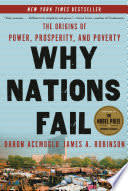
NEW YORK TIMES AND WALL STREET JOURNAL BESTSELLER • From two winners of the 2024 Nobel Prize in Economic Sciences, “who have demonstrated the importance of societal institutions for a country’s prosperity” “A wildly ambitious work that hopscotches through history and around the world to answer the very big question of why some countries get rich and others don’t.”—The New York Times FINALIST: Financial Times and Goldman Sachs Business Book of the Year Award • ONE OF THE BEST BOOKS OF THE YEAR: The Washington Post, Financial Times, The Economist, BusinessWeek, Bloomberg, The Christian Science Monitor, The Plain Dealer Why are some nations rich and others poor, divided by wealth and poverty, health and sickness, food and famine? Is it culture, the weather, or geography that determines prosperity or poverty? As Why Nations Fail shows, none of these factors is either definitive or destiny. Drawing on fifteen years of original research, Daron Acemoglu and James Robinson conclusively show that it is our man-made political and economic institutions that underlie economic success (or the lack of it). Korea, to take just one example, is a remarkably homogenous nation, yet the people of North Korea are among the poorest on earth while their brothers and sisters in South Korea are among the richest. The differences between the Koreas is due to the politics that created those two different institutional trajectories. Acemoglu and Robinson marshal extraordinary historical evidence from the Roman Empire, the Mayan city-states, the Soviet Union, the United States, and Africa to build a new theory of political economy with great relevance for the big questions of today, among them: • Will China’s economy continue to grow at such a high speed and ultimately overwhelm the West? • Are America’s best days behind it? Are we creating a vicious cycle that enriches and empowers a small minority? “This book will change the way people think about the wealth and poverty of nations . . . as ambitious as Jared Diamond’s Guns, Germs, and Steel.”—BusinessWeek
Average Rating
Informations
About the author
Daron Acemoglu, James A. Robinson
Author
Why Nations Fail
by Daron Acemoglu, James A. Robinson
Books Like Why Nations Fail
If you're looking for books similar to Why Nations Fail, here are some recommendations based on themes, tone, and narrative style.

Guns, Germs, and Steel
Jared Diamond
A groundbreaking exploration of why some societies developed faster than others, examining geographical and environmental factors that shape human civilization. Diamond investigates how access to resources, domesticable plants and animals, and environmental conditions influenced societal development. The book provides a comprehensive analysis of human history through a geographical and ecological lens. It offers deep insights into how different societies evolved and why some became more technologically advanced.

Development as Freedom
Amartya Sen
A Nobel Prize-winning economist's perspective on economic development as a function of human freedom and capability. Sen argues that development should be measured by individual opportunities and freedoms, not just economic metrics. The book challenges traditional views of economic progress and highlights the importance of social and political institutions. It provides a nuanced understanding of how economic systems impact human potential.

Capitalism and Freedom
Milton Friedman
A seminal work exploring the relationship between economic and political freedom. Friedman argues that economic liberty is fundamental to political liberty and societal progress. The book provides a powerful critique of government intervention in economic systems. It offers a compelling perspective on the role of free markets in societal development.

Poor Economics
Abhijit V. Banerjee and Esther Duflo
A revolutionary approach to understanding poverty through rigorous empirical research. The authors challenge conventional wisdom about economic development by examining micro-level behaviors and decisions of poor individuals. The book provides evidence-based insights into how poverty works and potential strategies for alleviating it. It offers a nuanced, ground-level perspective on economic challenges.
Economic Origins of Dictatorship and Democracy
Daron Acemoglu and James A. Robinson
A companion work by the same authors exploring how economic conditions shape political systems. The book examines the complex interactions between economic interests and political institutions. It provides a deep analysis of how economic structures influence democratic and authoritarian governance. The work offers critical insights into political economic dynamics.

The Origins of Political Order
Francis Fukuyama
A comprehensive analysis of how political institutions emerge and evolve across different societies. Fukuyama traces the development of political systems from prehistoric times to the French Revolution. The book examines the complex interactions between social structures, political institutions, and economic development. It offers deep insights into how governance shapes national prosperity.

The Institutional Revolution
Douglas W. Allen
An exploration of how institutions shape economic and social outcomes throughout history. Allen examines the evolution of economic and social institutions from pre-industrial to modern times. The book provides a detailed analysis of institutional change and its economic implications. It offers sophisticated insights into how organizational structures impact societal development.

The Great Transformation
Karl Polanyi
A seminal work analyzing the emergence of market economies and their social implications. Polanyi explores how economic systems are embedded in social and cultural contexts. The book provides a critical examination of economic development and social change. It offers profound insights into the complex relationship between economic institutions and society.
The Wealth and Poverty of Nations
David S. Landes
An in-depth study of economic development across different cultures and historical periods. Landes explores why some nations prosper while others remain impoverished, focusing on cultural, technological, and institutional factors. The book provides a comprehensive examination of global economic disparities. It offers critical insights into how institutions and cultural practices shape economic outcomes.
The Rise and Decline of Nations
Mancur Olson
A groundbreaking analysis of how economic and political institutions impact national prosperity. Olson explores how interest groups and institutional structures can either promote or hinder economic growth. The book provides a sophisticated understanding of economic stagnation and development. It offers critical insights into the dynamics of national economic performance.
The Lever of Riches
Joel Mokyr
An exploration of technological innovation and its role in economic development. Mokyr examines how technological progress shapes economic growth across different societies. The book provides a comprehensive analysis of innovation's impact on economic transformation. It offers insights into how technological capabilities influence national prosperity.

The Great Divergence
Kenneth Pomeranz
An exploration of why Europe, rather than China, became the first region to industrialize. Pomeranz challenges Eurocentric narratives of economic development by providing a comparative historical analysis. The book examines complex economic, technological, and institutional factors that led to divergent developmental paths. It offers a sophisticated understanding of global economic transformation.

State, Society, and Markets in Ethiopia
Alemu Asfaw
An in-depth study of institutional development and economic challenges in Ethiopia. The book examines how political and economic institutions shape national development. It provides a detailed analysis of economic transformation in an African context. The work offers critical insights into institutional dynamics in developing economies.

Why Europe Grew Rich
Jack Goody
An anthropological examination of European economic development and global economic disparities. Goody explores historical, cultural, and institutional factors that contributed to Europe's economic rise. The book provides a critical analysis of how social structures influence economic outcomes. It offers insights into the complex dynamics of global economic development.
No account connected — sign in to comment.