
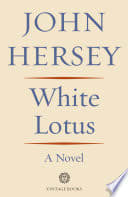
White Lotus
by John Hersey
Description
Not too far from now, in a world very like our own, the oppressors have changed places with the oppressed. After their defeat in the Yellow War, the white people of America are thrust into a brutally altered reality. They are hunted like wild beasts and drive like cattle, transported in reeking ships and sold to their conquerors as field hands and house slaves. Robbed of their old names and their old language, treated with a mixture of cruelty and condescension by their Chinese masters, whites take on new identities and new strategies of survival. Some, like Nose, plunge into dissipation. Others, like Top Man, become imitation Yellows. And some, like White Lotus, rebel. In this mesmerizing book John Hersey creates an alternate history that casts a harsh radiance on our own. It has some of the stateliness of Exodus, along with the power of oral narratives of slavery. It has heroes and victims—and villains who turn out to be victims of another color. At once a masterpiece of storytelling and a complex novel of ideas, White Lotuscompels us to reexamine our notions of race and racism, freedom and oppression.
Book Details
You Might Also Like
Twisted Games - Special Edition
Ana Huang

First In Series Collection
Christina McKnight
Fahrenheit 451
Ray Bradbury
The Talisman
Stephen King, Peter Straub
The Gorge
Scott Nicholson
Ready Player One
Ernest Cline
The Favorites
Layne Fargo

Call Me by Your Name
André Aciman
The Henna Artist
Alka Joshi
Where the Crawdads Sing: Reese's Book Club
Delia Owens
About the Author
John Hersey
John Richard Hersey was an American writer and journalist. He is considered one of the earliest practitioners of the so-called New Journalism, in which storytelling techniques of fiction are adapted to non-fiction reportage. In 1999, Hiroshima, Hersey's account of the aftermath of the atomic bomb dropped on Hiroshima, Japan, was adjudged the finest work of American journalism of the 20th century by a 36-member panel associated with New York University's journalism department.
No account connected — sign in to comment.