
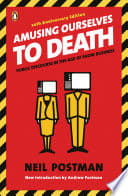
Amusing Ourselves to Death
by Neil Postman
Description
What happens when media and politics become forms of entertainment? As our world begins to look more and more like Orwell's 1984, Neil's Postman's essential guide to the modern media is more relevant than ever. "It's unlikely that Trump has ever read Amusing Ourselves to Death, but his ascent would not have surprised Postman.” -CNN Originally published in 1985, Neil Postman’s groundbreaking polemic about the corrosive effects of television on our politics and public discourse has been hailed as a twenty-first-century book published in the twentieth century. Now, with television joined by more sophisticated electronic media—from the Internet to cell phones to DVDs—it has taken on even greater significance. Amusing Ourselves to Death is a prophetic look at what happens when politics, journalism, education, and even religion become subject to the demands of entertainment. It is also a blueprint for regaining control of our media, so that they can serve our highest goals. “A brilliant, powerful, and important book. This is an indictment that Postman has laid down and, so far as I can see, an irrefutable one.” –Jonathan Yardley, The Washington Post Book World
Book Details
You Might Also Like

About the Author
Neil Postman
Neil Postman was an American author, educator, media theorist and cultural critic, who eschewed digital technology, including personal computers and mobile devices, and was critical of the use of personal computers in schools. He is best known for twenty books regarding technology and education, including Teaching as a Subversive Activity (1970), The Disappearance of Childhood (1982), Amusing Ourselves to Death (1985), Conscientious Objections (1988), Technopoly: The Surrender of Culture to Technology (1992) and The End of Education: Redefining the Value of School (1995).
No account connected — sign in to comment.