
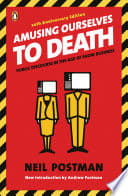
What happens when media and politics become forms of entertainment? As our world begins to look more and more like Orwell's 1984, Neil's Postman's essential guide to the modern media is more relevant than ever. "It's unlikely that Trump has ever read Amusing Ourselves to Death, but his ascent would not have surprised Postman.” -CNN Originally published in 1985, Neil Postman’s groundbreaking polemic about the corrosive effects of television on our politics and public discourse has been hailed as a twenty-first-century book published in the twentieth century. Now, with television joined by more sophisticated electronic media—from the Internet to cell phones to DVDs—it has taken on even greater significance. Amusing Ourselves to Death is a prophetic look at what happens when politics, journalism, education, and even religion become subject to the demands of entertainment. It is also a blueprint for regaining control of our media, so that they can serve our highest goals. “A brilliant, powerful, and important book. This is an indictment that Postman has laid down and, so far as I can see, an irrefutable one.” –Jonathan Yardley, The Washington Post Book World
Average Rating
Informations
About the author
Neil Postman
Author
Neil Postman was an American author, educator, media theorist and cultural critic, who eschewed digital technology, including personal computers and mobile devices, and was critical of the use of personal computers in schools. He is best known for twenty books regarding technology and education, including Teaching as a Subversive Activity (1970), The Disappearance of Childhood (1982), Amusing Ourselves to Death (1985), Conscientious Objections (1988), Technopoly: The Surrender of Culture to Technology (1992) and The End of Education: Redefining the Value of School (1995).
Amusing Ourselves to Death
by Neil Postman
Books Like Amusing Ourselves to Death
If you're looking for books similar to Amusing Ourselves to Death, here are some recommendations based on themes, tone, and narrative style.
1984
George Orwell
A dystopian novel depicting a totalitarian society where media and language are used as tools of control. Orwell explores how information can be manipulated to serve political interests. The book shows how media can be used to suppress individual thought and maintain political power. It provides a powerful narrative complement to Postman's analytical critique.

Brave New World
Aldous Huxley
A dystopian novel that eerily predicts a society controlled through entertainment and technological distraction. Huxley imagines a world where people are pacified by constant stimulation and pleasure, losing their capacity for critical thinking. The novel explores themes of media manipulation, technological control, and the erosion of individual autonomy. It resonates deeply with Postman's critique of entertainment-driven culture.

Discipline and Punish
Michel Foucault
A philosophical examination of power, surveillance, and social control in modern institutions. Foucault analyzes how power operates through systems of observation and normalization. The book reveals how social institutions shape human behavior through subtle mechanisms of control. It provides a theoretical framework for understanding media's role in constructing social narratives and controlling public perception.
Technopoly
Neil Postman
Another seminal work by Postman that explores how technology dominates and transforms culture. The book argues that technological systems become so pervasive that they redefine human values and social interactions. Postman critiques how technology changes our understanding of truth, knowledge, and social relationships. It serves as a natural companion to 'Amusing Ourselves to Death' by extending the analysis of media's cultural impact.
The Age of Surveillance Capitalism
Shoshana Zuboff
An analysis of how digital technologies enable unprecedented forms of economic and social control. Zuboff explores how tech companies monetize personal data and predict human behavior. The book reveals the complex ways digital platforms shape individual choices and social interactions. It updates Postman's critique for the digital age.
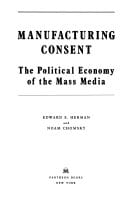
Manufacturing Consent
Edward S. Herman and Noam Chomsky
This book critically examines how mass media and communication systems function as propaganda tools for economic and political elites. It explores how media narratives are shaped by powerful interests, distorting public understanding of social and political realities. The authors develop a propaganda model that explains media bias and manipulation. Like Postman's work, it offers a deep critique of media's role in shaping public discourse and democratic processes.
Simulacra and Simulation
Jean Baudrillard
A philosophical exploration of how media and representation replace reality with simulated experiences. Baudrillard argues that contemporary culture is dominated by signs and images that have no connection to reality. The book examines how media creates hyperreal environments that obscure authentic experience. It offers a postmodern perspective on media's transformative power.
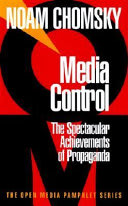
Media Control
Noam Chomsky
A concise analysis of how media serves power structures in democratic societies. Chomsky explains how media narratives are constructed to maintain political and economic hierarchies. The book reveals the subtle mechanisms of propaganda in ostensibly free societies. It offers a sharp critique of media's role in shaping public perception.
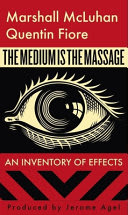
The Medium is the Massage
Marshall McLuhan
A groundbreaking exploration of how media technologies fundamentally alter human perception and social structures. McLuhan argues that the medium through which information is transmitted is more significant than the content itself. The book uses innovative graphic design to illustrate its complex ideas about communication and technology. It provides a philosophical foundation for understanding media's transformative power.
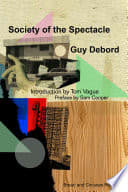
Society of the Spectacle
Guy Debord
A critical analysis of how media and consumer culture transform social relationships into spectacles. Debord argues that authentic human experiences are replaced by representations and images. The book explores how capitalism and media create a world of passive consumption and alienation. It offers a radical critique of media's role in shaping social consciousness.
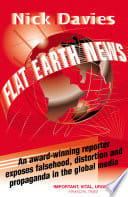
Flat Earth News
Nick Davies
An investigative examination of modern journalism's systemic failures and distortions. Davies reveals how economic pressures and corporate interests compromise journalistic integrity. The book explores how media organizations prioritize speed and sensationalism over accuracy. It provides a contemporary investigation of media's declining standards.
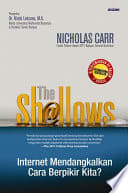
The Shallows
Nicholas Carr
An exploration of how digital technologies are reshaping human cognition and attention spans. Carr argues that the internet and digital media are fundamentally changing how we think, read, and process information. The book examines the neurological impacts of constant digital stimulation and fragmented attention. It extends Postman's critique into the digital age, analyzing how new media technologies alter cognitive processes.
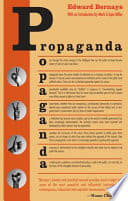
Propaganda
Edward Bernays
A foundational text on how psychological techniques can be used to manipulate public opinion. Bernays, considered the father of public relations, explains how media and communication can be used to shape social attitudes. The book reveals the systematic methods of influencing mass behavior through strategic communication. It offers insights into the mechanisms of media manipulation.
Public Opinion
Walter Lippmann
An early exploration of how media shapes public perception and democratic processes. Lippmann argues that most citizens' understanding of political issues is mediated through simplified narratives and stereotypes. The book examines the gap between actual events and public representations. It provides historical context for understanding media's role in constructing social reality.
No account connected — sign in to comment.